
On this page
Begin with the ShieldA Worked Example: the Duke of WaiteThe TincturesWhich Side Is Dexter?Read the Record as Well as the ImageBegin with the shield
The shield, or escutcheon, carries the central design of the arms. Its background is the field; figures placed upon it are charges. An animal, a tree, a snowflake, or a geometric figure can all be charges.
The complete arrangement is an achievement of arms. Reading it element by element helps distinguish the design of the shield from the additional bearings recorded with it.
- Crest
- The device above the helmet. The Duchess of Rees has a rising Cornish chough as her crest.
- Wreath or torse
- The twisted band commonly placed beneath a crest. Many records here specify a wreath “of the colors.”
- Mantling
- The drapery extending from the helmet, commonly drawn as elaborate foliage-like folds.
- Supporters
- Figures supporting or standing beside the shield. Their use in Westarctica depends on entitlement or approval.
- Compartment
- The ground or setting beneath the achievement, such as an ice floe or waves.
- Motto
- A phrase associated with the bearer, usually displayed on a scroll.
- Badge
- A separately described emblem. It may repeat an element of the arms or have a distinct design.
- Standard
- A heraldic flag whose design can bring together a badge, crest, motto, and national symbolism.
A worked example: the Duke of Waite
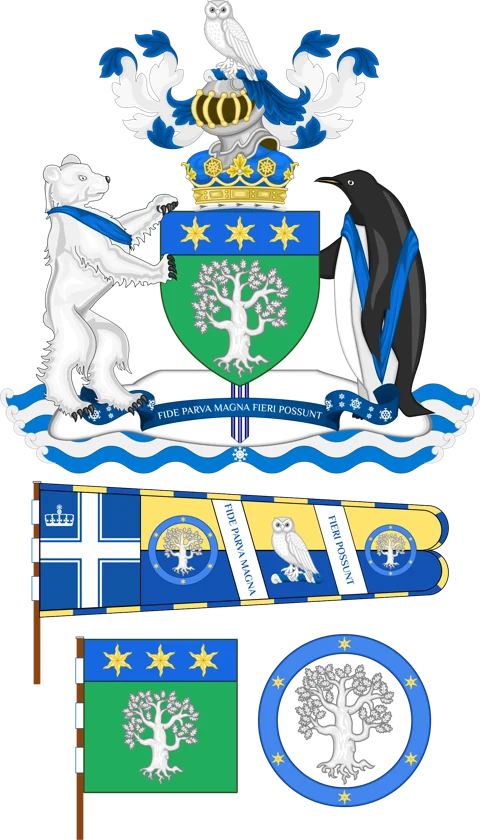
Vert, a Tree of Life Argent, on a chief Azure three estoiles Or
- Vert: the field of the shield is green.
- A Tree of Life Argent: the principal charge is a silver or white Tree of Life.
- On a chief Azure: a blue band crosses the upper part of the shield.
- Three estoiles Or: three gold stars with wavy rays appear on that chief.
The record then describes the other components separately: an owl crest, a polar bear and Adélie penguin as supporters, an iceberg compartment, a motto, a standard, and a badge. The shield’s blazon does not have to describe every feature of the full achievement in one sentence.
The tinctures
Heraldry uses conventional names for its metals and colors. The ordinary vocabulary encountered in this register includes:
These swatches illustrate the color names; a blazon ordinarily does not fix a single digital shade. Proper describes an object in its natural coloration. Furs have their own patterned treatments: Ermine, for example, uses black ermine spots on a white ground.
The familiar rule of tincture favors color on metal or metal on color. Westarctica treats this as guidance rather than an absolute requirement; see Westarctican practice.
Which side is dexter?
Directions are given from the shield-bearer’s point of view. Dexter is the bearer’s right, which appears on the viewer’s left; sinister is the bearer’s left. Chief refers to the upper area, and base to the lower area.
The word chief can also name the broad band across the top of a shield. “In chief” describes a position; “on a chief” describes charges placed upon that band.
Read the record as well as the image
The July 2026 Brisborough record illustrates the value of documentary context. It identifies a confirmation of inherited quarterings and names the Garcia and Dwyer coats in the blazon. A viewer can see the four divisions in the picture; the record explains what was confirmed and for whom.
Check the record type, date, bearer, and individual components before interpreting an achievement. A new grant, a confirmation, and an office badge each record a different kind of heraldic act.
Sources & further reading
- Court of the Lord Lyon — blazoning ↗
- College of Arms — FAQs: heraldry ↗
- Gallery of Westarctican Arms — 2025 onward ↗
References consulted 14 November 2026.