
On this page
The National AchievementThe First Arms: 2005Greater and Lesser Arms: 2015Continuity in a New Design: 2020The national achievement
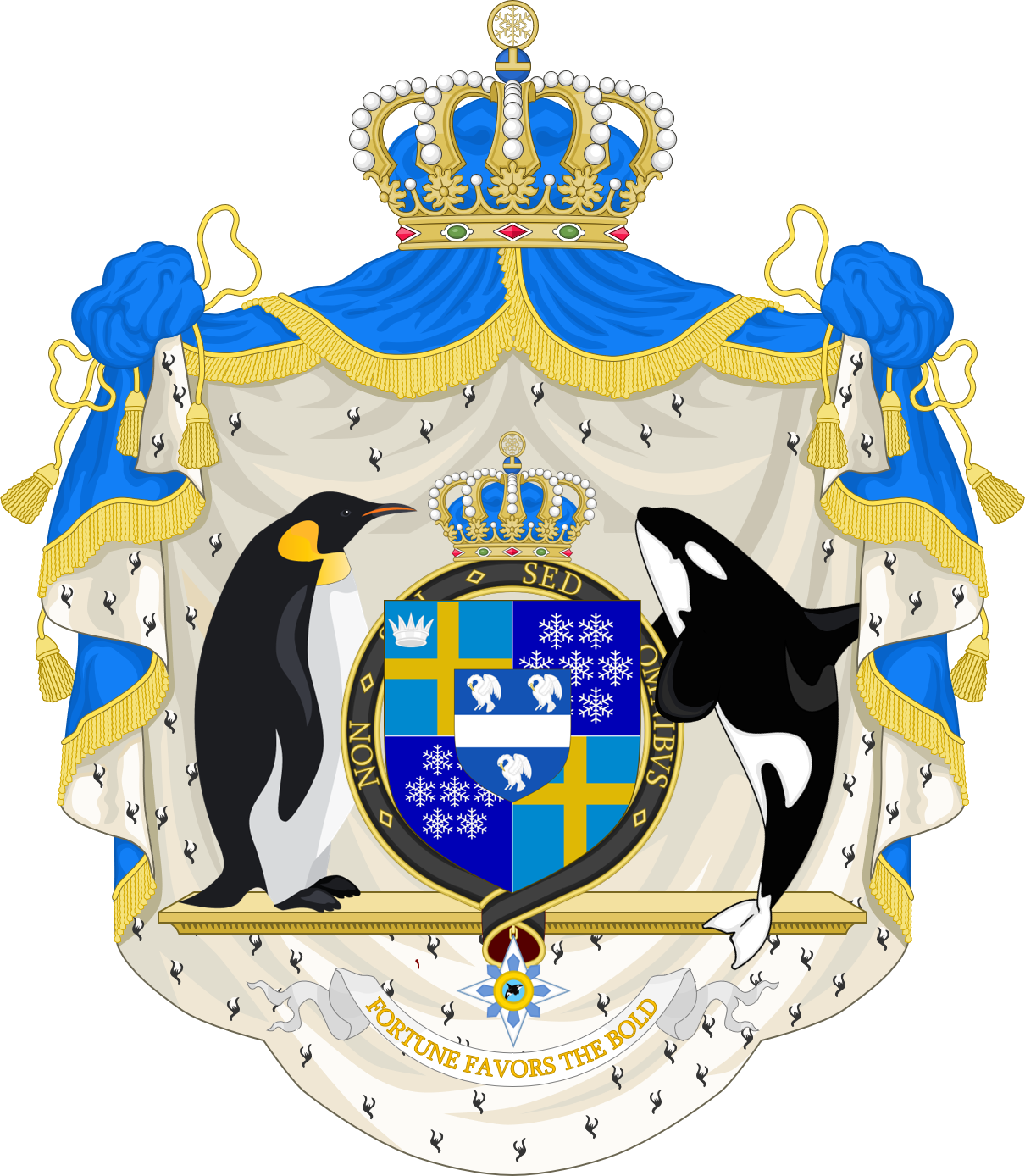

Westarctica’s national arms combine imagery from successive periods of the nation’s history. The present design was created in 2020 by the Baron of Abele, then Ellsworth King of Arms, and adopted by Royal Decree RD-2020-002.
The quartered shield brings together a gold cross and crown with fields of silver snowflakes on blue. A smaller central shield, or inescutcheon, bears the McHenry design, including three pelicans. The full achievement uses an emperor penguin and an orca as supporters.
The design serves both as the national arms and as the personal arms of the Grand Duke of Westarctica. It therefore combines institutional and dynastic identity in one achievement.
The first arms: 2005
Jon-Lawrence Langer created the first national coat of arms in January 2005 while serving as Chief Herald. The design drew on the national flag while using gold and sky blue to distinguish the arms from it.
Early versions appeared on coinage and in the Grand Duke’s correspondence. More elaborate treatments added lion supporters and a grand ducal crown.
Greater and Lesser Arms: 2015
In early 2015, Michael Richards, the first Ellsworth King of Arms, produced a new achievement commissioned by Grand Duke Travis. Known as the Greater Arms, it used lion supporters and the ornamental chain of the Order of the Snowflake and appeared on important state documents.
Erik White, Baron of Forrester, proposed a second design: white snowflakes on dark blue, with orca supporters. Adopted as the Lesser Arms, this became a widely used expression of national loyalty and appeared on stamps, banknotes, and in honorary consulates.
Continuity in a new design: 2020
The 2020 arms brought the earlier cross-and-crown design and snowflake imagery into a single quartered composition. The McHenry inescutcheon added the Grand Duke’s family identity.
The result shows how an achievement can preserve several strands of history at once. The design is also a useful introduction to quartering, an inescutcheon, and the distinction between a shield and its supporters.
Sources & further reading
References consulted 14 November 2026.